FAST moves in all directions
As I write this, there are no reviews on Rotten Tomatoes for Rob Tregenza's latest film, Fast. On Metacritic, there are two.
I know it screened for several days at MoMA in New York, one night in Los Angeles with Acropolis, and then a three-day mid-week run at the Laemmle Glendale. I bought my ticket to a Monday afternoon in Glendale and that ticket read: FAST X, a completely different movie. When I arrived, there was one other person in the screening room. Now I wonder if anyone showed up during those three days thinking they were about to see a Vin Diesel movie.
Anyway, you won't find all that much in the way of reviews, but if you're the kind of moviegoer who scans whatever local venues there are for non-mainstream films – arthouses, museums, film societies, places like that – that's where you might find Fast. I do hope you find it screening somewhere. I'm concerned for the public wellbeing of this film; I want its discrete existence to matter. I also want to explain Fast, but that's somewhat more difficult.
It opens with a train entering a tunnel, one with no light at the end. Then it seems as though that train backs out of the tunnel instead of passing through.
A woman named Sterling (Madison Pankey) comes back to her hometown in Virginia after leaving for law school, then leaving law school. She wants to race cars instead. The first person she runs into, at a junkyard where she may be employed, is a man who acts like an old flame. She responds to his appearance with friendliness. When he tries to rape her, she kills him with a crowbar.
He shows up again in flashbacks, his presence unresolved. His death and others – Sterling's long-deceased mother and father, and some unnamed characters from a distant Southern past, dressed in antebellum costumes, who drift through, unexplained, in various scenes – hover over her unexpected return.
Meanwhile, living family and friends, people in the town both friendly and combative, compete for attention in Sterling's life, but come in second to her desire to leave again and to do so in a fast car.
Sterling's world is a circle, a concept made literal in one sequence where Tregenza's camera – he's also worked as a cinematographer, notably on Béla Tarr's Werckmeister Harmonies – moves around the junkyard, clocklike, as characters repeat the same actions over and over.
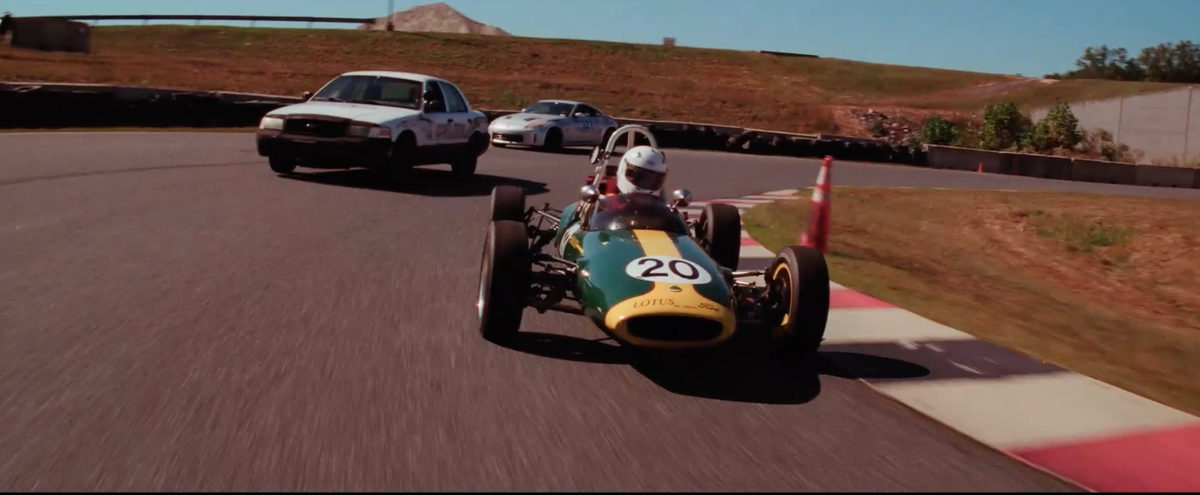
Time itself is another strange loop in Fast, mimicking a race track, the place where Sterling most wants to be. As she rebuilds a vintage F1 car to realize her dream of becoming a competitive driver, the past and present overlap in unpredictable ways. It's a minimalist narrative that doesn't build in any particular direction; sequences come and go, more suggestive than expository, as do characters who move into and out of the frame, pressing Sterling for engagement.
What Fast refuses to present in terms of a story with a beginning or ending, it delivers conceptually. Black-and-white scenes shift to color in a pattern of Tregenza's own logic, and spinning wheels announce themselves metaphorically, a way of straddling both motion and stasis, contentment and simmering impatience, light and darkness, success and failure.
And because this is a Rob Tregenza film, he's telling a story and and reinforcing the viewer's position as observer of that story – the object and the act of watching the object being constructed – very much like he did with his last project, The Fishing Place, in which the movie stopped and a lengthy, behind-the-scenes third act arrived unannounced.
Here, Sterling's race-track freedom in her rebuilt car finds itself interrupted by footage of a post-production facility, the camera no longer aimed at the driver, but at multiple screens where Fast is being edited, or scored, or color-corrected, who knows. Finished.
There are no such things as spoilers in a film like Fast, so to note that it ends how it begins, in a train tunnel, is appropriate. Maybe Sterling gets what she wants. Maybe not. Tregenza isn't telling. This time, though, the light is visible, slowly moving closer.