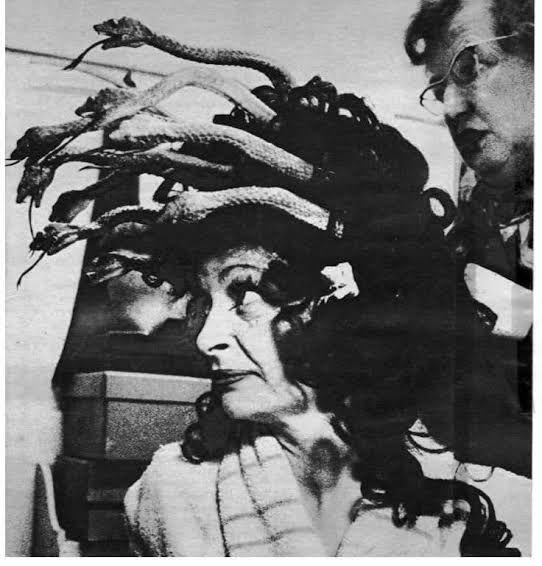
DETAILS: The wig in THE GORGON
You draw the lace curtains and open the floor-to-ceiling window to the normal-house-sized bedroom in your stately manor and a bat flies in and you faint but it's not because you're scared it's because the bat is a harbinger of sexual ecstasy and ruin and pretty soon you're going to fuck Dracula and become a vampiress and this is the most exciting thing that has ever happened to you because you live in a Hammer horror movie and otherwise everything in your existence is quite boring.
When I use the word "boring" to describe the mid-century horror films of the British production company Hammer, what I mean is that they're perfect. When all you want to do is sit on the couch with snacks and pay more attention to the aristocratic libraries, the anachronistic eye shadow, the frilly nightgowns, the accompanying décolletage of those frilly nightgowns, the busy wallpaper, the tweed caps, the pale blue coffins, the horse-drawn hearses, and the men in purple velvet suits than to the actual plot, which is frequently pretty stiff business, they are the perfect cozy conveyance.
On weekend afternoon television in the 1970s, if the local station wasn't showing a '50s sci-fi mutant creature film, or something starring Godzilla, or a classic Universal monster movie about Dracula, Frankenstein, The Mummy, or The Werewolf, the were showing a Hammer film about British Dracula, British Frankenstein, British The Mummy, Oliver Reed as a werewolf, or a tasteful batch of dullards being terrorized by an equally tasteful serial killer.
My favorite Hammer is The Gorgon. With appreciation to cartoonist Lynda Barry, who, in one of her autobiographical strips, immortalized her own complex childhood experience of watching this film, I learned early, before Halloween and Friday the 13th taught me to love a friendly neighborhood slasher, that this was my kind of horror movie. It pretended to scare you but it didn't, and the fun of it was learning how to be goth while eight years old. It had special effects I couldn't understand at the time but grew to love more when I finally learned how they had done it.
I'm talking about the wig, of course. All Hammer wigs were spectacular works of art, hair towers that one might just as well have found on top of Dolly Parton's head on The Porter Wagoner Show. But the wig in The Gorgon is special because the hair of it all is a secondary consideration. As a relic of mythology, Miss Gorgon is more or less Megaera – the one everyone mixes up with Medusa – and she's a phantom figure whose stare can turn people to stone. Her gimmick, of course, was that her hair was a bunch of snakes, which made you want to look. That's how she got you.
The snakey-head was accomplished by putting a seven-pound mechanical Hair Thing Plus Fake Snakes on top of British ballet dancer Prudence Hyman – after making her up to look like a terrifying monster – and then having puppeteers operate the creatures.
The results are, to this day, so disconcerting – again, I refer to Lynda Barry on this one for confirmation – that you want to watch her be monstrous again and again, to study it, and not just the last part where they chop off her head.
Hyman moves like a person whose body has been trained for career triumphs more elegant than this, but she commits all the same. She glides through the space. The diaphanous green gown she wears is serving effortless glamour-ghost, and thanks to that, she's as enticing as any sex-coded vampire. And then the snakes do their thing. Or, rather, the crew of dudes operating them does it.
The faux reptiles don't preen and undulate. They wiggle and jerk and shudder and snap. Because they don't flow naturally from the skull of a professionally trained dancer, they more resemble something you'd see at ShowBiz Pizza, a cheap, mechanical, carnival haunted-house treat. I want to watch them be wonky all day.
We live in a cinema environment where any spectacle can happen on screen but not much of it is thrilling. Hard-working effects people ruin their posture sitting at monitors to make that happen. But there's nothing to touch. Nothing to wonder about. If a film comes along that prides itself on its practical effects team, we hear about it before it ever comes to theaters. We might even go because we want to see that artistry. Everything has flipped upside down.
With The Gorgon, I think it's the juxtaposition of actor and prop that creates the power. Two opposing forces jammed together. If the film was made in 2026, those snakes would appear seamlessly real. No actor would need a chiropractor afterward because all they'd have on their head would be some green balls marking a location. Audiences would forget about it as soon they left the multiplex.
Analog pleasure, then, is forever because everybody got together and built that pleasure from actual parts. Those fake-ass Muppety snakes seemed like they were about to fall apart, and who knows, they might have in between takes. They sputtered and hissed in the 1960s so Bruce the shark could malfunction in the 1970s. They should be in a goofy effects museum precisely because they look like dime-store tricks and sound like gears grinding. They were never a flaw. They are canon. The reason for the season. I will always love them.