NEW/OLD: Bait + Enys Men
NEW/OLD is what I call pieces where I talk about older films (2025 back to whenever) that I've seen for the first time. Now you know.
On the next episode of Linoleum Knife, Alonso and I will be talking about Rose of Nevada, the latest film from director Mark Jenkin. I won't be writing about that film here. I want to tell you, instead, that Jenkin's two earlier films, Bait, and Enys Men, are available to be seen and that you should do as I have done and sit still with them.
Bait is a black-and-white drama about a fishing village in Cornwall and the disruption of its low key existence by outside forces. Rich people buy up inexpensive homes as vacation dwellings. Tourism takes over the small, isolated location. Capital forces everyone to bend to its will. At the center of the story are two brothers (Edward Rowe, Giles King) torn in opposite directions. Rage builds, and with it human danger that burns and envelops everyone.
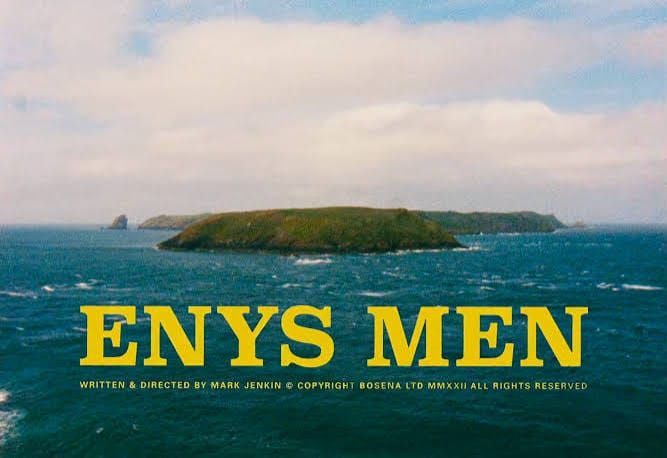
Enys Men, set in 1973 and in attention-grabbing saturated color – recalling era-specific films like Unman, Wittering and Zigo and The Wicker Man – is about a kind of internal horror amplified by the natural world and local folk legends. A botanist (Mary Woodvine) studies endangered flowers, only to find that her relationship to them has become symbiotic. She reads A Blueprint for Survival at night, and by day observes the plants, writing "no change" over and over as the days pass. Maybe it's a wish?
Some lichen makes an appearance. Those flowers change. And then so does the botanist. She's alone on the island, but her solitude is punctured by intruders that trouble her days and nights. Are they real?
Both films explore the haunting of the present by the past, and they push you deeper into their traps, their formal and narrative elements intersecting so thoroughly that one seems impossible without the other. Jenkin's process – he writes, directs, edits, and designs the sound – is, in fact, married to the past: both films were shot on a hand-cranked, 16mm non-sound camera, the dialogue and all other important noises added after.
His compositions are meticulous and elegant, demand your direct attention, and look like they were made with scraps of film he found on the sidewalk. They're stunning, uniquely his, and if they were digital it would all feel like a mistake.
Rose of Nevada, though not a sequel, or meant to be viewed in any sort of chronological order, is also about fishermen, ghosts, and deep, deep trouble. Made in similar fashion, it echoes the two that came before. In Jenkin's world, cozy seaside life is no longer immune to interruption. The steady order becomes chaotic and fishing boats disappear, homes are stolen or crumble, scars from the past get reopened and life starts to disintegrate, turning unrecognizable. You'll feel like you might need your own survival manual.