I saw BACKROOMS and SILENT FRIEND back to back. Now they're stuck that way.
If you watch a lot of movies and you're on the internet, then you've been made aware of Kane Parsons' Backrooms, and you have, perhaps, already heard or read more about it than you'd like. If that's you, bookmark this until you've seen the movie. Or skip ahead to the part where I talk about the film that stars a very big tree instead of a series of upsetting hallways.
Anyway, Backrooms is a wide release film that bears many marks of the arthouse, with its sequences of dialogue-free, sound-design-dense wandering and worrying. And for a film made by a 20-year-old director, it's shockingly aware of the ways traumatic life events live on and mutate through decades of quicksanding in the sub-basements of one's consciousness.
You enter what appears to be a haunted-house experience – with a furniture salesman (Chiwetel Ejiofore) and his therapist (Renata Reinsve) trudging down, down, down into an endless and architecturally impossible maze of sad laundry and broken chairs – only to find yourself sinking into a sorrow-filled trap as the characters' agonizing memories turn sentient.
It will bother people who give a shit about screenwriting, perhaps. I don't care about that. Lots of films I love have a loose or even non-existent relationship with characters, plot, and dialogue. Sometimes I prefer there to be none of those things at all. I can see any old movie try to half-ass that stuff; why not let's go with something else and power it all with tense atmosphere, fluorescent light, and self-pity. That's where Parsons goes. And in the end, he pulled off my favorite horror movie aftereffect: it made me feel terrible. Good job. Then there's the equally moodstruck and isolation-themed, though fully life-embracing, Silent Friend. It's here to soothe.
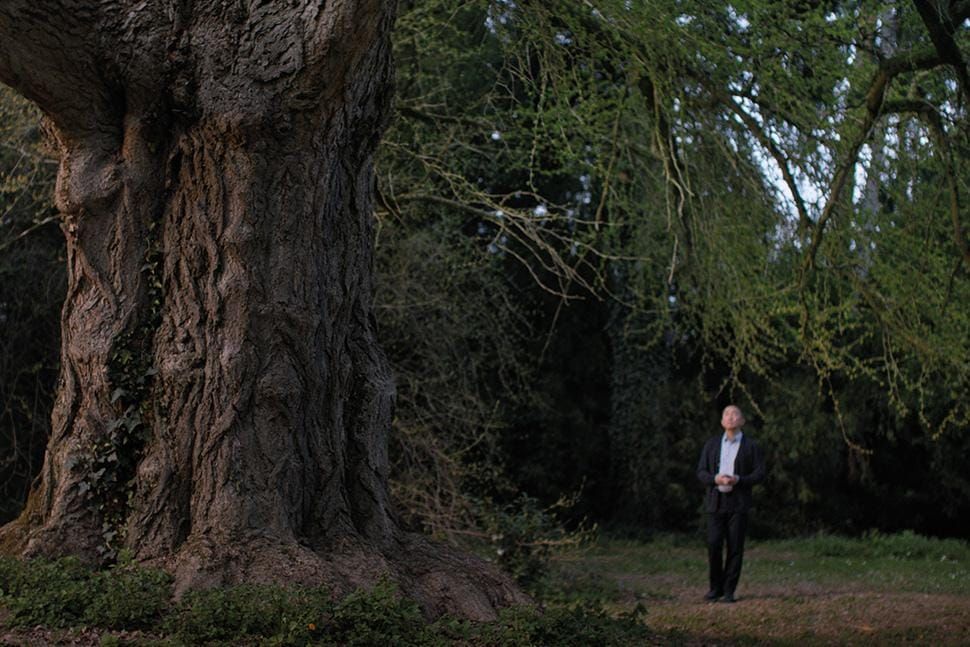
Trees throw apples at Dorothy. Winnie the Pooh gets stuck in one with his ass hanging out. Terence Malick really likes them. There's one in The Fountain that gives Hugh Jackman a trippy onscreen facial. But the tree at the center of Silent Friend is an enormous ginkgo on the grounds of a German university and, true to the title, it doesn't make anywhere near the fuss of the ones I just mentioned. It just takes up well-deserved space and allows itself to be the object of an adoring, scientific gaze.
It also observes its observers, thanks to repeated shots that serve as tree POV, a thousand leaves and branches filling the screen and, in one scene with the best iris shot in recent memory, a small gap of natural space where the audience is allowed to join the gigantic plant in spying on the tiny people below.
The most significant of those people are played by Tony Leung Chiu-wai, Luna Wedler and Enzo Brumm, in various time frames – 2020's COVID lockdown, the turn of the 20th century, and the early 1970s, respectively – all conducting their own versions of botanical inquiry.
Each of these eras is a moment of great change. In the early 1900s, Grete (Wedler) is the first woman admitted to study at the university. There, she forges ahead amidst all-engulfing misogyny, simultaneously locating her own power by building a photographic skill set to document her research. In the early 1970s, Hannes (Brumm) is a young student digging into Goethe's Metamorphosis of Plants to bond with a seductive geranium in a way that hums with psychic energy, analogous to his emerging feelings for fellow researcher Gundula (Marlene Burow).
In 2020, Tony (Leung Chiu-wai) is a neuroscientist stranded on campus with only a stern custodian (Sylvester Groth) for distanced, N95-obstructed company. With the lockdown comes a shift in Tony's focus: he was studying the neural responses of babies (they are, he concludes, "high all the time") but becomes enchanted by the secret life of the ginkgo. He attaches a metal belt of sensors to its trunk, as well as to his own head, and waits for what happens next, comparing notes over Zoom with a French colleague (Léa Seydoux).
Silent Friend is the latest from Hungarian filmmaker Ildikó Enyedi, a director not unfamiliar with the Backrooms-centric idea of people being buried alive, as well as with the presence of plot-point plants, from her own 1999 film, Simon, The Magician, in which a houseplant "witnesses" a murder and reacts accordingly.
Similarly, the over-200-year-old ginkgo and the much younger geranium are staring back and participating in the lives of the people studying them. They respond to what otherwise would go unnoticed. The opposite of, say, a busybody like Paddington, these plants spend their time unobtrusively constructing vibey bridges so imperceptible – while their subterranean roots talk to mushrooms and every other tree – that they need to be hooked up to probes and sensors for their engagement to be known at all. Oh, you think you just made a new friend all by yourself? Well, the ginkgo did that for you.
Not unlike Backrooms, Silent Friend makes a lot of narrative space for obsessive curiosity, with all its motivations and mixed-up takeaways: burrowing in can cement you in your own trouble, or it can open up the world in front of you. And both of them travel paths flooded with cinematic associations, films that explore interiors and exteriors, connection and loneliness, darkness and light. See also: Jem Cohen's Little, Big, and Far; Roman Polanski's Repulsion; Tsai Ming-liang's The Hole; Pierre Creton and Vincent Barre's entire botanical cinematic output; the far-out deep-forest climax of Apichatpong Weerasethakul's Memoria; Jane Schoenbrun's We're All Going to The World's Fair. In all of these films, the pull to withdraw and the urge to reach out are forces too powerful to resist. Either can stop you dead in your tracks.
The horror of Backrooms and the hope of Silent Friend work together, in a way, and chaperone visitors into both the void that hangs out, waiting for us to fall helplessly deeper, and the whole-body pleasure that happens when you take the internet's most obnoxious advice and actually touch grass. There's not a two-title-card-length shout out to "Featured Plants" in Silent Friend's end credits for no reason.