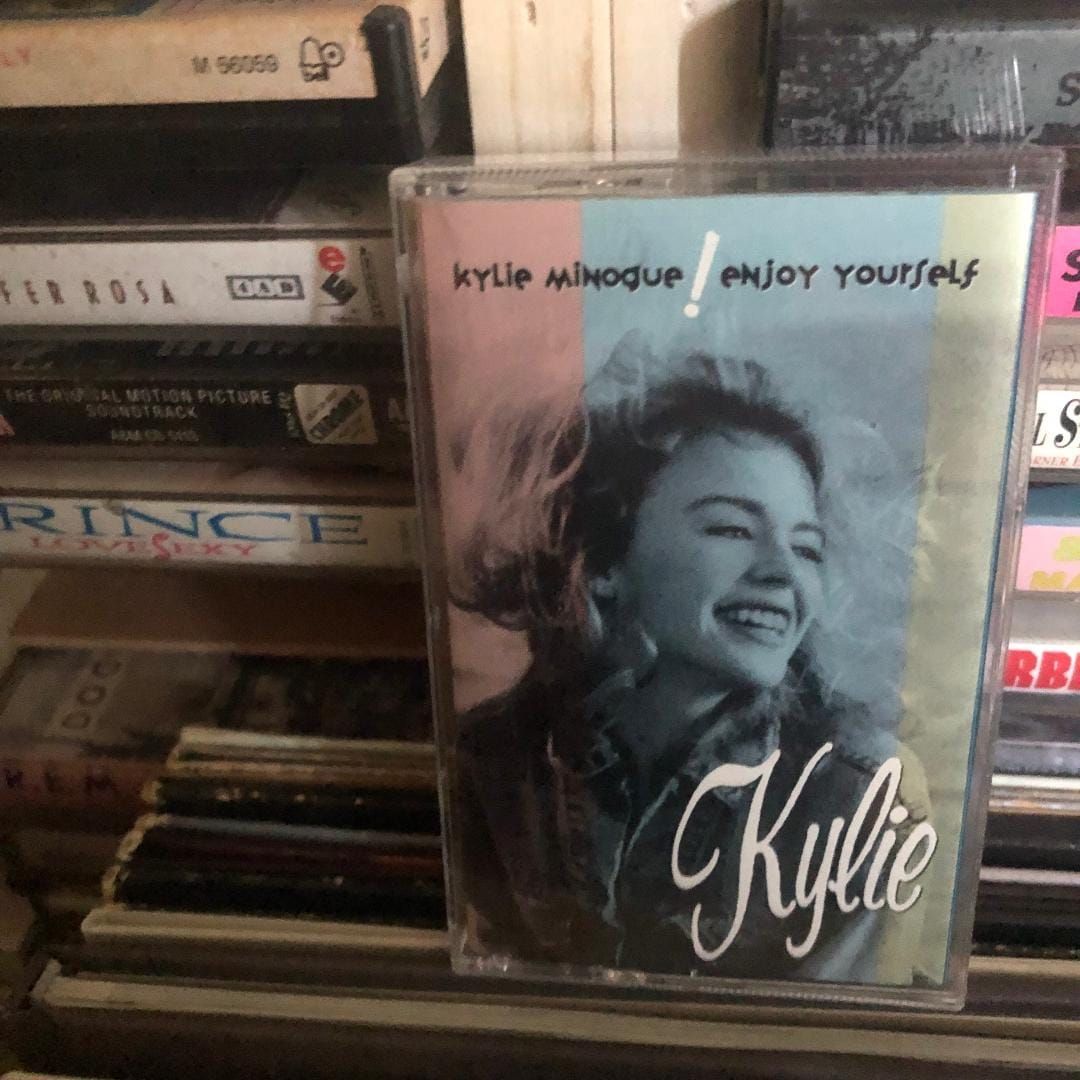
! Enjoy Yourself
One Saturday afternoon in spring of 1989, I was on a subway in London with a friend. We had been to record shops and spent money. The Pixies album, Doolittle, had just been released, and if you got an early copy, it came with a limited edition booklet, and that was exciting. We both bought one.
I don't remember what other records he bought, but among my purchases that day was a 7" single from Kylie Minogue, "Hand on Your Heart." My friend was appalled.
I had only recently sorted out that she was the girl from "The Locomotion," a grating song that was a huge hit in the United States and that I hated. Upon its release I thought she was Stacey Q. Later, the music video for her single, "I Should Be So Lucky," was on some children's program on Nickelodeon. That song was not a huge hit in the U.S. but I made the connection. She wasn't Stacey Q. She was some other girl.
I had been watching Top of The Pops each week during my semester-long stay in England because you're not not going to tune in to a show where pregnant Neneh Cherry performs "Buffalo Stance." Kylie Minogue had just been on, performing "Hand on Your Heart." I liked it immediately. It's an incongruously happy heartbreak song embedded in gleaming production, an invitation to a shopping mall where everything was suddenly free for you because you're sad. I especially liked her vocal delivery, like she was on a cheerleading squad, fired up and ready. Whatever the technical term is for singing that's also yelling, she was doing it, every note an opportunity to shout with her whole body.
"Don't buy that."
"I am going to buy it."
On the train back, my friend took it out of my bag and stared at it: "You're so stupid." He emphasized the STU.
I flipped it over. There was a logo for the record label, PWL. I had learned that they were the label – and specifically the songwriting team of Stock-Aitken-Waterman – behind a series of exceptionally catchy singles from Bananarama, Dead or Alive, and Rick Astley. The tagline under the logo, "The Sound of a Bright Young Britain," provoked instant distrust, and it probably had something to do with Thatcher, who I knew to be evil, but I was also American and not equipped to parse out the possibly sinister political aspects of the U.K.'s upbeat cultural production.
I said, "Here is a record label that makes manic, dancey little songs that all sound alike and that appeal to kids. Then those kids will grow up and remember them and love them forever. Twenty years from now you think some wedding DJ is going to play My Bloody Valentine? No. It'll be Mel & Kim."
"You cannot like both the Pixies and this."
"Yes, I can. I'm doing it right now."
In the 80s, lots of hardline post-punk enthusiasts would sometimes draw this line in the sand. Not long after, in 1990, there was a book being passed around called Rock and the Pop Narcotic. As one might imagine, it was a bad resource, full of shitty misogyny and homophobia. (To be clear, though, my heterosexual Pixies pal was neither of these things.)
The friendship survived this aesthetic clash and in the 90s he sent me mix tapes with lots of Teenage Fanclub songs on them, but now here's a note about me being absolutely correct: just before COVID, Bananarama reunited their original lineup and went on tour. At the Los Angeles show, the crowd went apeshit for all of their S-A-W songs. Corroborating evidence: in 2025, 36 years after that day, also in Los Angeles, Kylie Minogue packed Staples Center and it was a night of euphoria. My friend Mark showed up wearing a custom t-shirt that read: MINOGUE NOT JENNER.
This is all to say that yesterday, Netflix dropped a three-part documentary, Kylie, and I stayed up late to watch it all. Of all the interview subjects, it was Kylie collaborator Nick Cave, Mr. Release The Bats himself, who had the most insightful and gratifying analysis of her significance, referring to her music as "all giving" and a "joy machine."
So yeah, right again.